

Do you remember paint-by-number kits growing up? It was always a fun gift to receive because year to year you would get a few more colors and a more complex “work of art” to create. You might begin with 7 mini-pots of paint for a simple rainbow, move on to a dozen colors for a landscape or birds in flight, graduating to twice that many choices for a spring garden scene. Now I see that you can even design, print, and paint your own canvas with 60 colors. While those were fun, creative activities, the end result always seemed to be the same: it looked like a paint-by-number masterpiece; that is, you achieved your goal but it remained unpolished. What if you applied a similar principle to learning French?

The Pareto Principle, also known as the 80/20 rule, is a concept that states that, for many outcomes, roughly 80% of the effects come from 20% of the causes. Examples that I have seen cited were that 80% of the time, you will wear the same 20% of your clothes and 80% of your footsteps fall on the same 20% of your carpet’s surface. For learning French that suggests that knowing the most common 20% of words in the language will allow you to understand about 80% of daily conversations and written text. Coincidentally I often read that you should strive to understand at least 80% of a story/conversation/lesson to feel as if you have mastered the topic.
In an endless search for that one magic method that will make acquiring French effortless, I daily consult that one source of all knowledge: YouTube. Given that I am subscribed to 17 channels devoted to learning the language and another dozen covering a variety of topics in French, it’s no surprise that the platform’s algorithms often have a new “For You” channel to suggest, with the most recent being Le French Café. According to teacher Muriel:
- Out of the 12,000 French verbs recorded, about 300 are really common in both spoken and written French, and only around fifty are enough to handle most everyday situations.
- In conversation, the present tense is used in about 60% of exchanges.
- A French dictionary contains over 100,000 words. Fortunately, only 3,000 to 5,000 words allow you to understand and express yourself in 80% of common situations. (And I’ve seen that number as low as 1000).
- The passé composé is used in over 90% of cases to talk about the past in spoken French.

Rather than listing here those 50 verbs and the 5 tenses that she says form the foundation of 90% of spoken and written French, I’ll attach 2 pdf documents below that provide the details. So, will this method leave you with a “paint-by-number” masterpiece? Perhaps, but that’s the point. In our opinion, the goal is to communicate. If by focusing on the essential 20% of the language, you can achieve 80% (or even 90%) of your communication goals, we think that’s a great result.
Please note: This is not an endorsement of any particular learning method and we would have no monetary gain if you were to follow Muriel’s channel. It’s just an interesting topic of discussion.
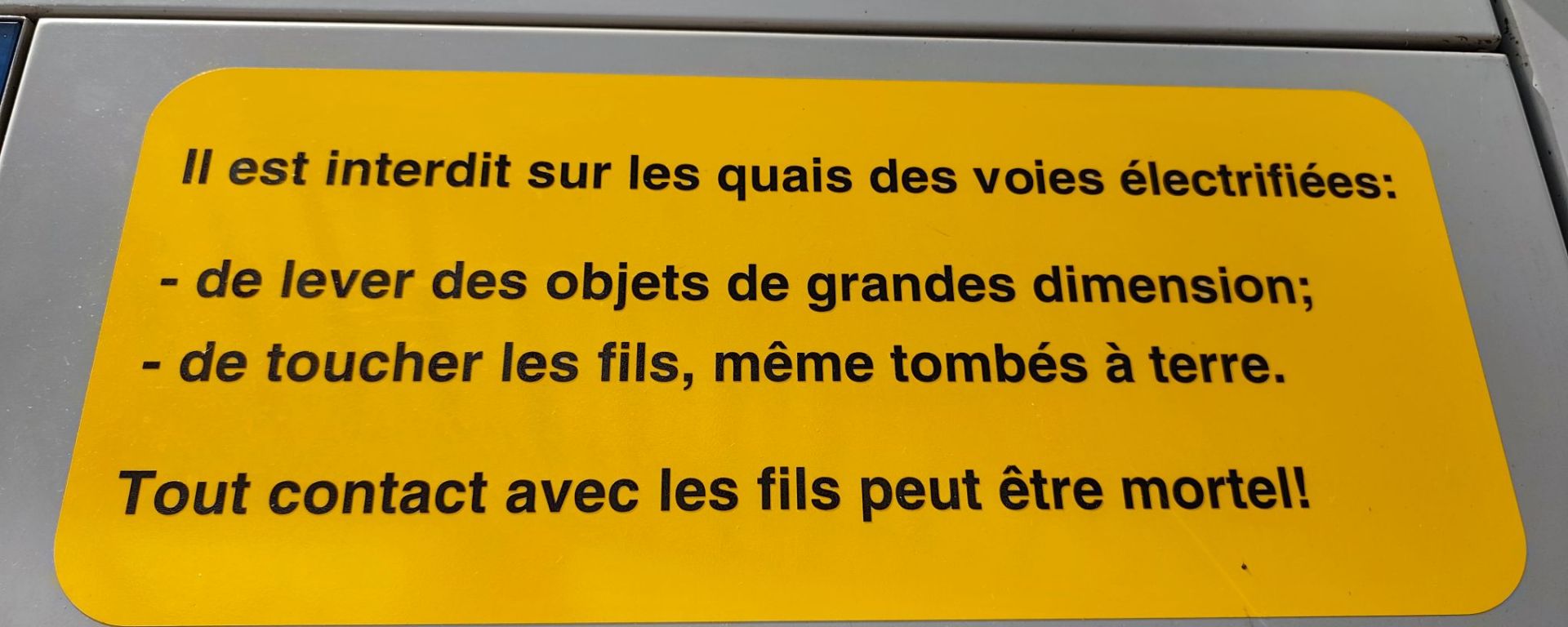
Photo notes: You might need a certain level of French and a sense of humor to understand some of today’s signs. The featured photo is a warning sign at a train station in Luxembourg but the final line, out of context, could be saying that “any contact with the sons can be fatal”.
 Let's Live In France
Merci! I might give it a shot!
LikeLiked by 1 person
Great, Wendy, that will put you ahead of the game when you make the big move! 😉
LikeLiked by 2 people
Bob,
Thanks for this post, I’ll peruse the documents and see how far I have to go until I am able to communicate 80% of the time lol!
LikeLiked by 2 people
I’d say that you’re already 80% of the way to your 80% goal! 👍
LikeLiked by 2 people
Having completed four years of two to five times per week French lessons and still speaking like a toddler, I appreciate this perspective!
LikeLiked by 2 people
Bravo, Sandy, for your impressive study habits! By the way, even toddlers can get their messages across 🤣
LikeLiked by 1 person
Bob,
Thanks for the post, I’ll check with the attachments to see if I am able to communicate 80% of the time lol.
LikeLiked by 3 people
Great advice as always
LikeLiked by 3 people
Another well-researched and well-considered article! Merci. We are just returned from a gratifying week of immersion on l’Ile de Ré. Meaning…we got so much from the experience, including the renewed realization that language acquisition is a lifelong journey.
LikeLiked by 3 people
You are so right about that lifelong journey and it’s not too bad to be enjoying part of that trip on the beautiful Ile de Ré! 🏖️🌞
LikeLiked by 1 person
When I was in a Catholic boarding school in Ireland many (many) years ago I had the Hail Mary in French drilled into my head where it still remains. Sadly it is of limited use in everyday life so I shall move on to the most popular verbs ! Bound to be more helpful 😳
LikeLiked by 3 people
What, Gary, you don’t use, “Le fruit de vos entrailles” in your daily conversation at the bakery? 😲
LikeLiked by 2 people
Might scandalise the good people of Perigueux!
LikeLiked by 3 people
Parfait! Merci.
LikeLiked by 2 people
I could have used this information years ago when I was studying French. Maybe then, I would have had something to say to Veronique the beautiful Lab teacher.
LikeLiked by 2 people
When I first started learning French in school, the Beatles’ song “Michelle” was popular so all of the other boys found it easy to remember, “Michelle, ma belle, sont les mots qui vont très bien ensemble.” Given that no one was named Michelle, they didn’t get to use it much, LOL!
LikeLiked by 1 person
Loved this post!! It “almost” sounds easy!! Is there a formula like this for pronunciation??
LikeLiked by 2 people
Good question, Elaine! I haven’t used the following website but the description says “It’s built on the idea that training your ear to hear the 20% of sounds that don’t exist in English will fix 80% of your accent” and I believe that they offer a free introductory course. https://fonetix.org/en/accueil
LikeLike
Merci pour la recommandation! I’ve recently discovered Frenchoclock on Instagram. He has a lot of good videos covering French phonemes, which I’m really finding useful, as that’s one of my sticky points for spoken French.
LikeLiked by 1 person
Thanks for that tip! It’s always good to find one more way to improve.
LikeLike
Thank you for sharing this – I love it!!
LikeLiked by 1 person