

Learning French is easy—they said. After all, 60% of the words in English have their origin in France. If you can pronounce ver as in “very” you’re well on your way. Just take a look at this sentence: Le ver vert va vers le verre vert that might be translated as “The green worm goes towards the green glass” and with one simple sound you’ve made a really useful comment. The language learning experts at Berlitz put French at position 7 on their list of the easiest languages for English speakers to learn, just after Italian and right before Swedish. Visitors to Carcassonne, Ed and Cherri, said that they had been using Duolingo for about 2 years so when I saw an article about a study on this program’s effectiveness, I wanted to see the results.

The headline read, “Study Shows Duolingo Learning Outcomes Are Comparable to University Classes” which reminded me of a YouTube video where a teacher of Spanish evaluated Rosetta Stone for French and felt that it was equivalent to two years of university study. The 29-page report (funded by Duolingo) published in Foreign Language Annals concluded that after completing 5 units within Duolingo, learners did as well on reading and listening tests as students who had undertaken 4 semesters of university work with the bonus of taking less than half the time to finish their self-study program. Bill and I have used at least a dozen different audio/online/video/in-person classes over the years pursuing the goal of feeling comfortable in communicating in another language. Since Duolingo is free we might have to make that number 13.

In a related article, another study called “It’s a Myth That Adults Can’t Learn Languages as Easily as Kids” suggests that it’s the method in which each age group learns that makes the difference. Often children are with their friends in a relaxed atmosphere where they play games and watch videos while switching between speaking, listening, reading, and writing the target language. Their parents, on the other hand, might be found in a more traditional academic setting, learning by rote, and fearful of making mistakes. The conclusion was that immersion by practicing with other people was the best method, making learning as a family the ideal situation. An added benefit is that apparently the more variety of accents that we hear the more easily we learn words. We know for sure that our French friends who have a good command of English seem to understand our American-accented French better than those who aren’t comfortable in our native language.
And speaking of accents, the best advice I’ve seen on that topic came from a neuroscientist at the University of Edinburgh, Dr. Thomas Bak, who said, “someone from England who moves to Scotland will not sound Scottish, and vice versa.” Sounds a lot like that book by Richard Carlson, Don’t Sweat the Small Stuff, and It’s All Small Stuff.

To conclude with one more useful sentence that shows how easy it is to speak French, in this example from Alex & Tom of “AT Frenchies” you simply pronounce the vo of “vote” and the la of “lay”: Le veau laid violet volait le volet et volait le vieux lait. So now you’ll know what to say the next time you see an ugly purple calf stealing a shutter and flying the old milk. Facile, non?
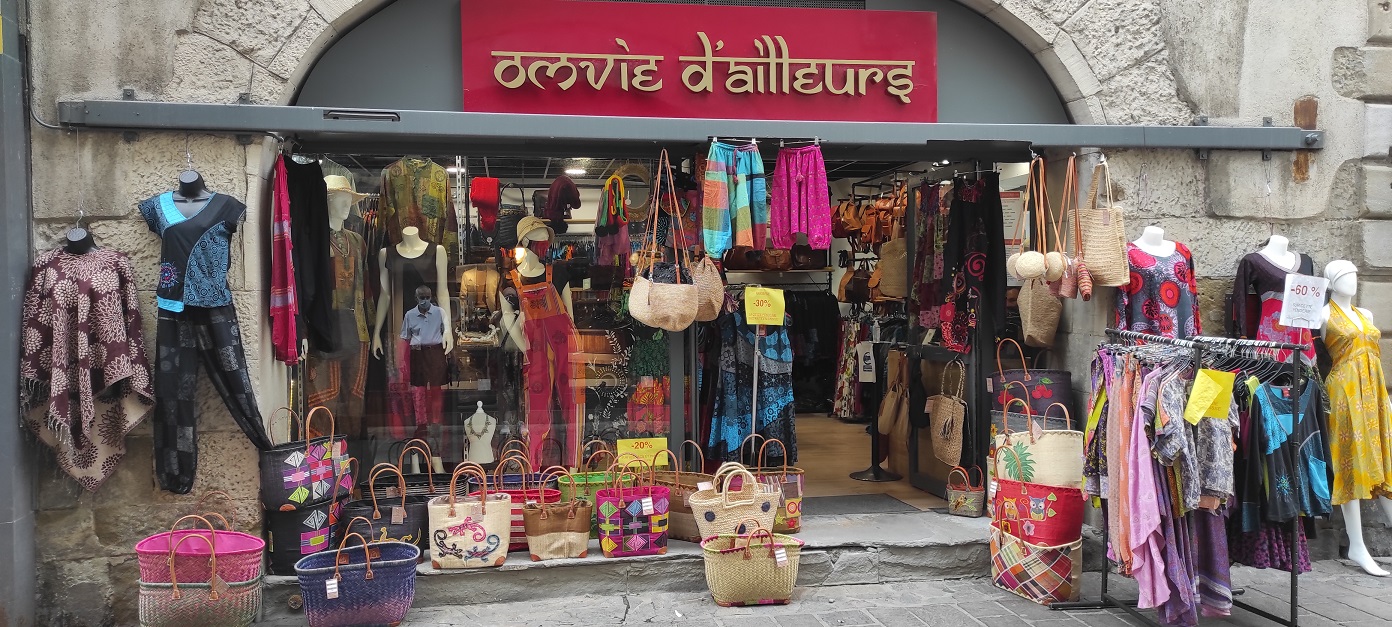
Photo notes, both in Carcassonne: The featured photo across the top is a colorful pop-up shop and in the first paragraph is a rooster, one of the many symbols of France, in front of the restaurant Maison Joseph.
For one more laugh, here’s something I saw on the Facebook group, Everything French. You don’t have to speak the language to understand that both sides are struggling. Hint: the person below labeled “Me” is making nonsensical comments beginning with, “The dog respects the rabbit” and then it goes comically downhill from there.

 Let's Live In France
I’ve been using Duolingo on and off for years – the droll (drôle) Facebook example is great. Nonetheless the site has been of great use to me and the method of throwing phrases at learners is well orchestrated and builds on what a learner already knows. I hope you enjoy it!
LikeLiked by 1 person
OK, Katherine, but don’t blame us if the next time we see you we greet you with, “The dog respects the rabbit, LOL 🐕🐇
LikeLike
🤣🤣
LikeLike
This is great! Learning French is SO hard, but you’re right, practicing with the amazingly kind French people I encounter every day is most helpful. Even les voisines I encounter in the elevator help me. One funny example: I tried to tell our contractor that I’d left my sweater in a restaurant, and the staff kept it for me until I returned. I pronounced “pull,” sweater, like “poule,” which means chicken–so he understood that I’d left my chicken at the restaurant. It took a second to figure that one out! Thanks for posting this.
LikeLiked by 2 people
Hi Sandy, I bet most of us make humorous mistakes like that. I figure it makes for good dinner conversations at French households across the country! Maybe your contractor thought that you were cold without a sweater and guessed that you were saying “chair de poule”, the French equivalent of “goose bumps”. Just being creative 😂🤣
LikeLike
Thank you so much, I really like your story. Monique
>
LikeLiked by 1 person
Hi Bill and Bob. We love reading your posts. And we are still practicing with Duolingo. We are planning a return trip to SW France including Carcassonne this fall. Hope to be further along in our French than “the dog respects the rabbit” by the time we return. Just last week I learned ” Chaque jour, la vache regarde des trains”. LOL
Cherri and Ed
LikeLiked by 2 people
It will be a pleasure to see you again and now well be on the lookout for that cow that looks at trains 🙂
LikeLike