

What happens when you put Cary Grant and Sophia Loren on a dilapidated and leaking houseboat moored on the Potomac River somewhere in the countryside outside Washington, DC? If it’s 1958 then you get an Oscar nominated romantic comedy called “Houseboat” with a happy ending. If it’s 2023 and you move the location to France, replacing the Hollywood actors with real boat owners, do you still get romance with a cheerful conclusion? I wrote about our brief consideration of life on the water in Narrow Dog to Carcassonne which explains why we’re on dry land but we still get questions about canal boats. An online article in The Local (France) prompted me to investigate what it means when “a man’s/woman’s home is his/her castle” floating in a river.

Blogs, websites, and videos with titles that include “Floating Home in France…Living on a Canal Boat…and…Retire to a Barge” all give personal experiences related to my search using the Local’s article title, “What you need to know about living on a boat in France”. Although Bill and I never got beyond the dream of a houseboat, all of these sources address the real life issues you need to deal and here are some of their points in common:
Waterway—You’ll need an occupancy agreement, called a Contrat d’Occupation Temporaire du domaine public, from the governmental agency that oversees your choice of canal, river, or other body of water. Even if you buy a boat with this contract in place, you’ll need a new one as the new owner since it covers the resident(s) and not the vessel.
Visa or residency card—Although your new home might not have a fixed address, it’s still located in France which means that if you’re not a citizen of France or another EU country it will be necessary to have a visa or residency card to stay longer than 90 days out of every 180 days.
Mooring—While it’s certainly possible to sail along aimlessly, stopping for an overnight on a whim, everyone had the same warning: don’t tie up to a tree as that is strictly prohibited. That said, most people seem to settle on a marina to act as home base which can also help by providing an address for that Contrat d’Occupation mentioned above and your visa or residency card. Budgets varied dramatically depending on the marina’s location with a low of 2000€ per year up to 10,000€. I would guess that higher figure would be for Paris which could be an advantage if you are applying for citizenship. The capital has the fastest processing time in the country for all of the naturalization paperwork you must provide.
Licensing—If you have a motor of more than 6 horsepower you need a driver’s license that will include a written rules test plus a trip with an examiner to make sure that you can handle the boat. There are several driving schools in Carcassonne, all of which seem to offer a similar service to boat owners with a price of around 500€ to 600€ for the training and exam.
Maintenance—Every few years you’ll spend 10,000€ for drydocking, painting, and repairs. Every 10 years a required hull inspection will be 2000€ plus the drydocking. Perhaps 2000€ per year for upkeep.
Insurance—The budgets I saw were from 1000€ to 2500€ per year for the vessel itself, not the contents.
Taxes—Local authorities will determine if your floating domicile is more of a house, and therefore subject to property tax (taxe foncière) or genuinely a boat without that burden. In either case you are still a French resident and subject to the appropriate income taxes depending upon your situation.
Utilities—One blogger listed “no utilities” as a real advantage of houseboat life because she uses solar panels for electricity but still must count on filling her water tanks at a marina where her fellow boaters with more permanent moorings remain connected for all of their services. Even she sometimes uses the marina showers to save water onboard.
Purchase prices—According to pinch.com you could spend as little as 25,000€ for a fixer-upper, double that to get the same boat already in a livable condition or navigate on up to Paris where you could easily spend 1.8 million € to be on the Seine.

After reading all of that, I’m reminded why we’re content to live in a house that doesn’t bob up and down. When we want romance on the high seas, or even on the calm canal, we’ll just get out the “Houseboat” DVD and watch Cary and Sophia live happily ever after.
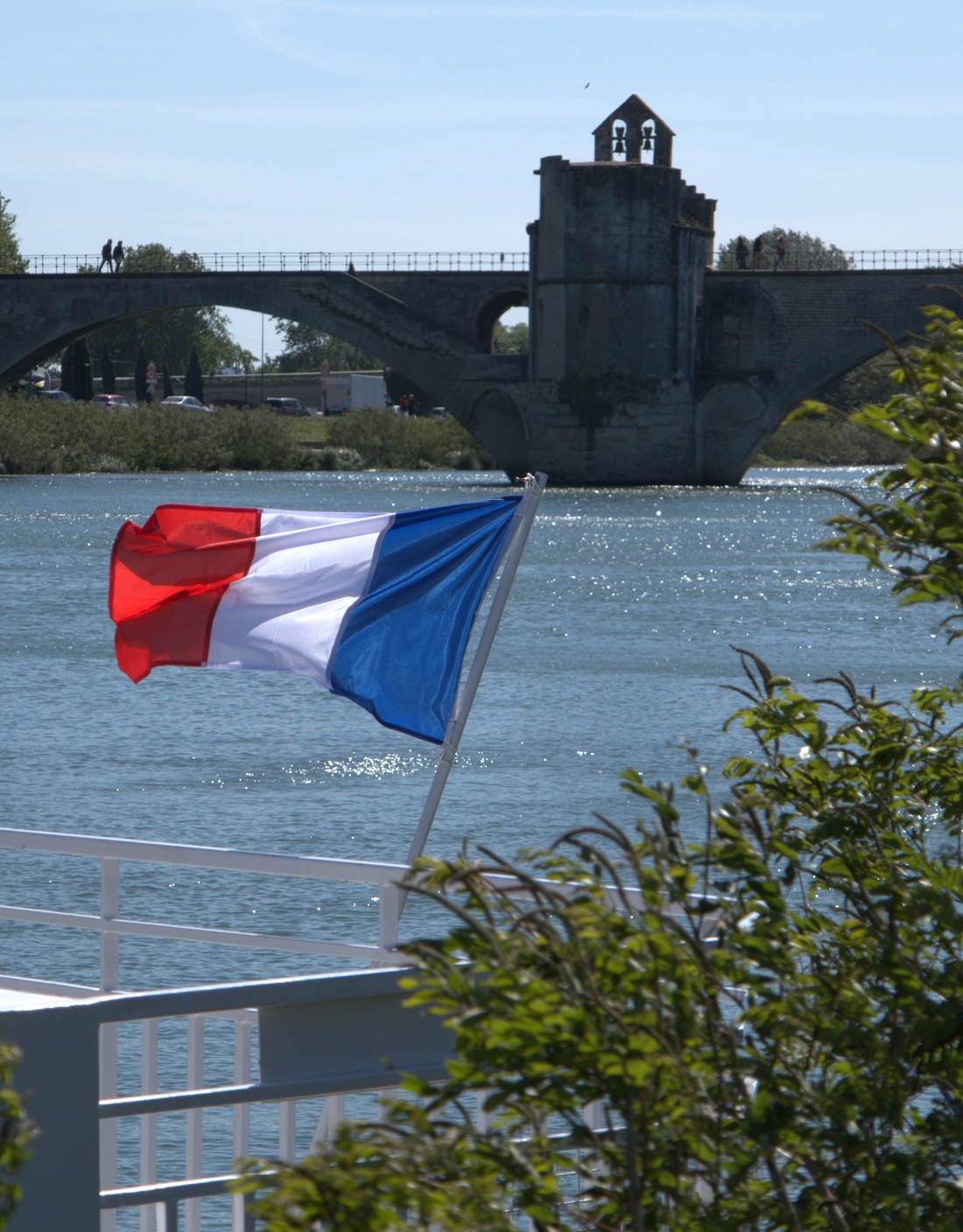
Photo location notes: Across the top, we’re on our way to Corsica. The next two are in Avignon, and the last grouping is in Aigues-Mortes.


Your posts always offer a treasure trove of unexpected info. Today’s entry has me wondering how you know which area has the fastest processing time for naturalization paperwork. Although I am almost as bemused by your knowing floating utility fees. Bravo…another piece plainly well-researched!
LikeLiked by 2 people
What nice things to say, thank you! There’s a Facebook group called “Applying for French Nationality” where members share their experiences from submitting their applications to becoming French citizens. Regularly I see Paris residents saying that from start to finish it has taken them 18 months or less; whereas, this morning someone who applied through the Montpellier préfecture (the one that our part of the country uses for naturalization) has her interview/test next month after a wait of 2 and 1/2 years. Patience, they say.
LikeLike
Incredibly useful advice as always but I’ll stay on dry land, thanks
LikeLiked by 1 person
I don’t know, Sheree, those walking/biking paths beside the canals can be pretty tempting 🚴♀️
LikeLiked by 1 person
Too flat for me plus too many mozzies
LikeLiked by 1 person
I love the Canal du Midi so much that I have wondered what living on it would be like. But if I ever had the opportunity, like you I think I’d choose to live on its banks rather than in it. 😉
LikeLiked by 1 person