
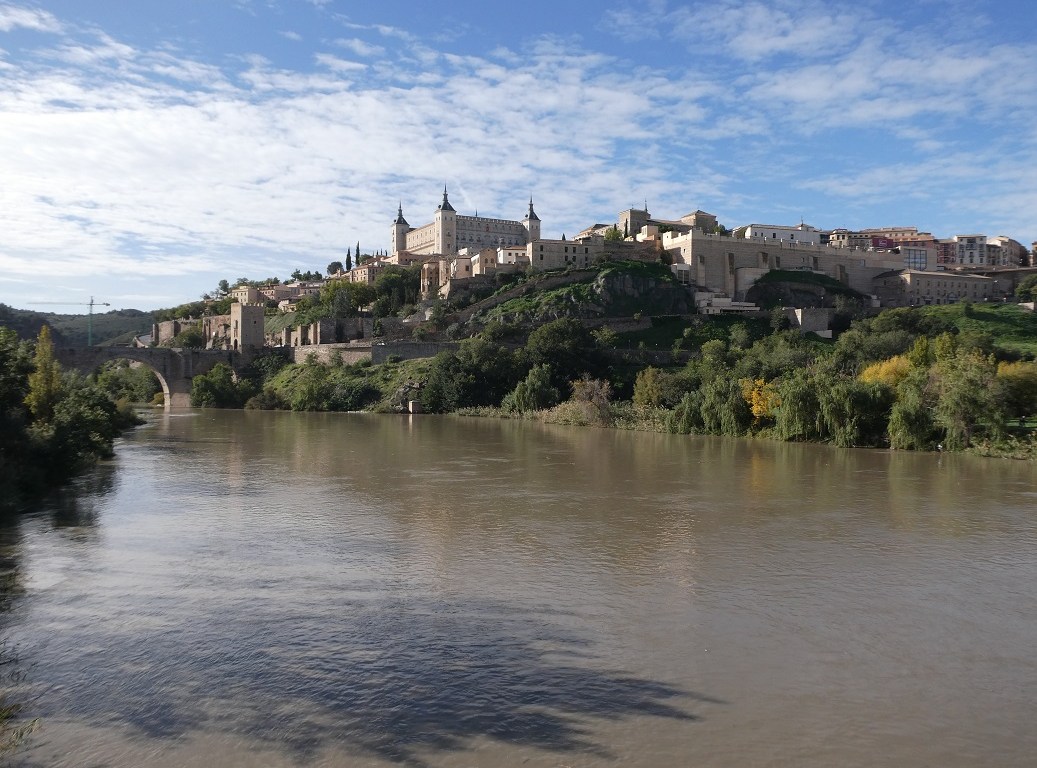
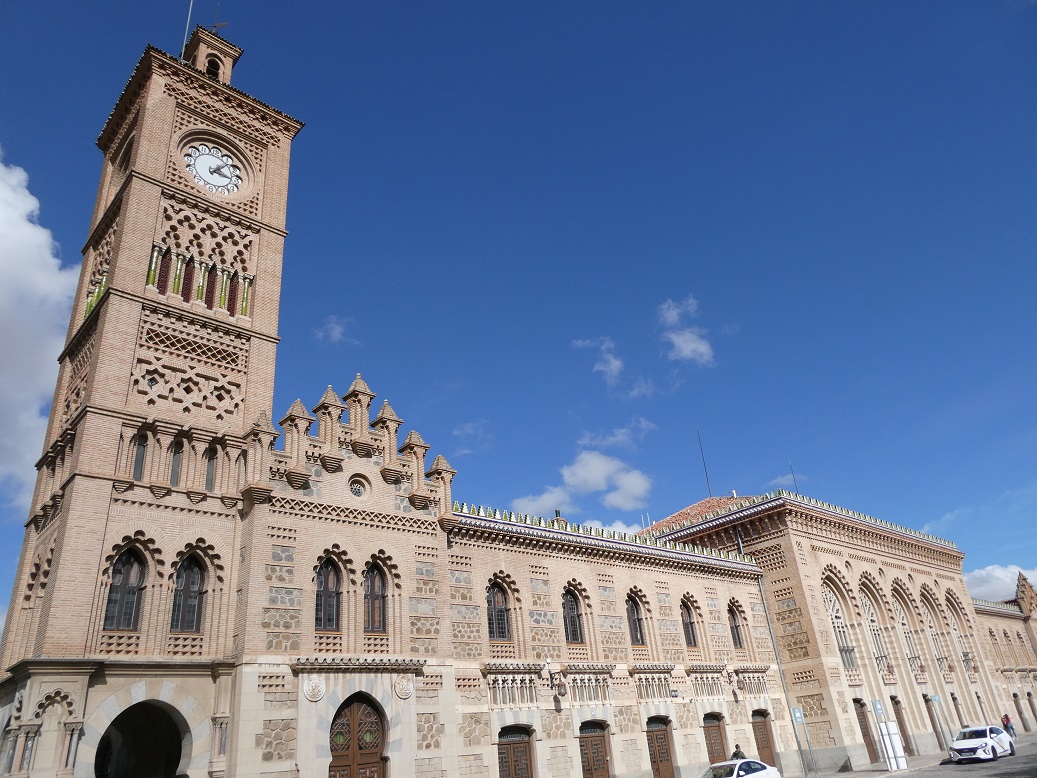
With a train every hour taking only 30 minutes it was easy to get from Spain’s current capital, Madrid, to the former capital and now a UNESCO World Heritage Site, Tolédo. In less than 10 minutes from exiting the train (station photo to the left), we were standing on the Azarquiel bridge admiring the view that you can see across the top of today’s blog post. We continued walking for 5 more minutes to what some might consider “cheating” but what we thought was “smart”: the free escalators that effortlessly take you up to the city. That saved a little time and a lot of climbing since the city sits about 40 meters (131 feet) above the river below.

The building that dominates the skyline when looking up from the Azarquiel bridge is the Alcázar. Built on top of a Roman fort, this Moorish fortress from 932 AD has four corner towers rising 60 meters (197 feet) high. During the Spanish Civil War it was a stronghold for Nationalist forces, later led by Franco, and today it’s an army museum.
When kings were using the Alcázar as a palace, they might have gone to our next stop to trade their horses, mules, and ponies. Plaza de Zocodover has been a meeting place for centuries and remains so today, minus the animals, with an abundance of cafés and restaurants.
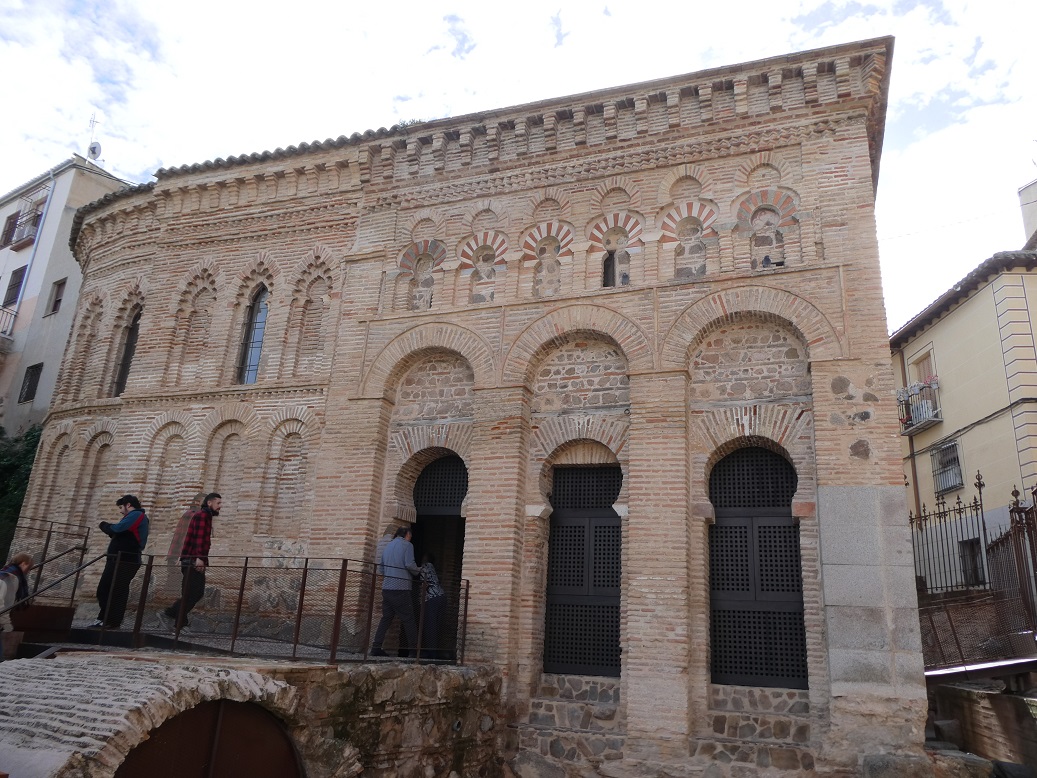
As you might guess from the name, Mezquita del Christo de la Luz (Mosque of Christ of the Light), this oldest monument in Tolédo dating from 999, began as a mosque and was converted in the 12th century to a church. The intricate brickwork exterior made its original purpose obvious to us.

The Jesuits were first allowed to live in Tolédo in 1558 and 70 years later they began construction on San Ildefonso that took 100 years and 100,000 bricks to complete. This church was intentionally built to focus any incoming light towards the high altar leaving the side chapels in relative darkness.
No visit to a Spanish city would be complete without seeing a cathedral so next we stopped at Santa Iglesia (Primada) that, like many other churches in this country, was built on top of a mosque. Construction began in 1226 and lasted for more than three centuries.
Built in 1356, the Sinagoga del Tránsito was a synagogue built for the thriving Jewish community of 14th century Spain. It’s decorated with Moorish elements, intricate geometric and floral patterns, plus Arabic and Hebrew inscriptions. When Jews were expelled from the country in 1492 the building was given by King Ferdinand and Queen Isabella to a Catholic order.

Just as the Alcázar dominates the view from the east side of the city, the Monasterio de San Juan de los Reyes does so from the west. This monastery from 1553 was commissioned by the King and Queen mentioned above to celebrate the birth of their son and to commemorate winning a battle against Portugal. A symbolic message is displayed on one exterior wall where chains and manacles are said to represent Christians freed by the Catholic monarchs by reconquering Granada from the Muslims in 1492.
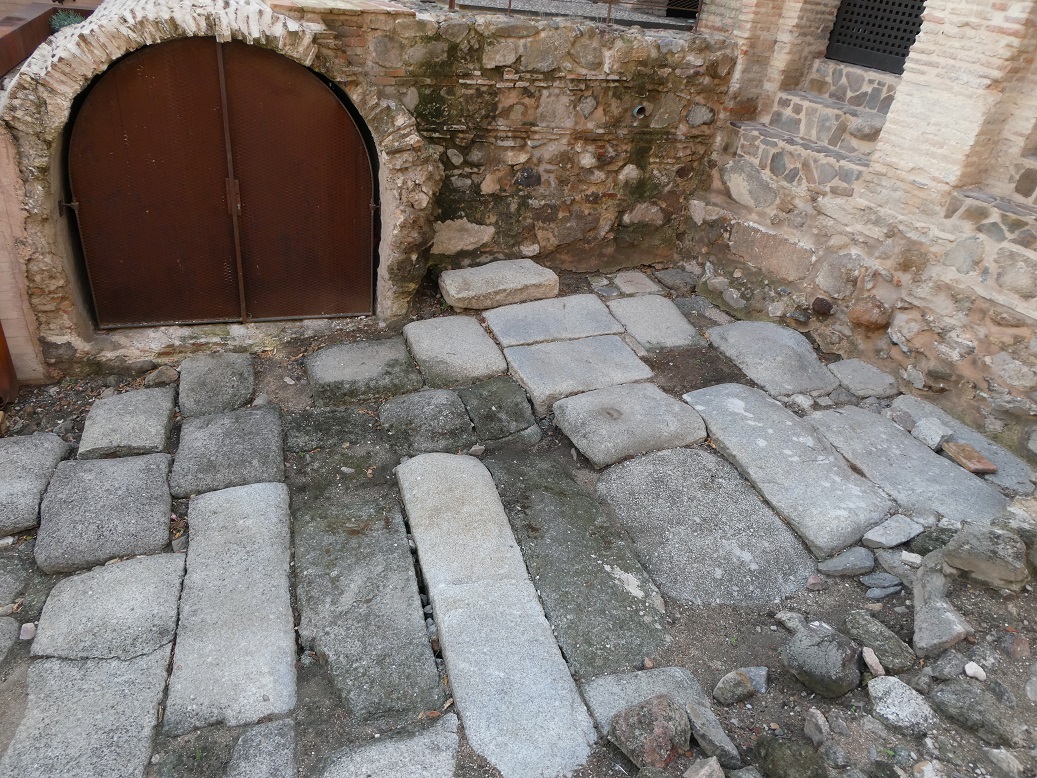
When I first glanced at the walking tour that we went on today, it seemed as if all we were going to see was churches, synagogues, and mosques. In essence that’s exactly what we did see, buildings from all 3 religions that are an integral part of the history of Tolédo. Next time we’ll move on into Andalucia, Spain, a region where again we’ll see a similar influence.


I’m somewhat ashamed to say that I have never been to Spain. Hoping to fix that in ‘24. Tolédo has a fascinating history – thank you for sharing it! Looking forward to the Andalucia installment. 😃
LikeLiked by 1 person
Yes, there’s so much to see! Next week it’s all about Granada which will tempt you even more 😁
LikeLike
I ran with the bulls in Pamplona in 2011! Even if you don’t intend to run, it’s worth a visit to see the Festival of San Fermin.
LikeLiked by 2 people
I first visited Toledo in 1981, time for a revisit.
LikeLiked by 2 people
And we know the perfect restaurant: Restaurante Alfileritos 24, fantastic!
LikeLiked by 1 person
Thank you, noted
LikeLiked by 1 person