

We’re not opera fans but we can appreciate the history that accompanies them. Such was the case two weeks ago when we spent the weekend in Seville, Spain. During our time “down south” we had already spent a week revisiting Madrid before going on to see the Alhambra in Granada where the locals would say that flamenco got its start. Now it was time to move on to a place that might give that latter city a bit of competition in both the origin of the dance and the splendor of their Moorish palaces.

We followed a 2-day general itinerary that suggested starting with the largest Gothic cathedral in the world, Catedral de Sevilla, that was built beginning in 1402 on the site of a mosque of which the 12th century minaret stands today as a bell tower. There are 80 chapels inside which explains why the cathedral walls could fully enclose a football stadium. In the south transept is a huge tomb said to hold the remains of Christopher Columbus although DNA tests have apparently been inconclusive.

Their next suggested stop was one that we put off until Sunday since we’d heard that much of the city closes down on that day. If we were sticking with the opera theme then we could have begun with the Real Alcázar since it was the setting for the first act of Carmen, where the soldier Don José meets the gypsy Carmen and falls under her spell. This 10th century fortress was transformed into a palace over the centuries and we saw both Moorish and Christian influences throughout. There are colorful tile floors, patterned walls and ceilings, arches, and columns. The beautifully maintained grounds (closed because of storm damage) include fruit trees, flowers, pools, and fountains. Because the Spanish royal family still uses the upstairs portion of Real Alcázar as a residence, we bought a timed ticket that gave us limited access to that area (no photos allowed) and full access to the rest of the building and gardens.
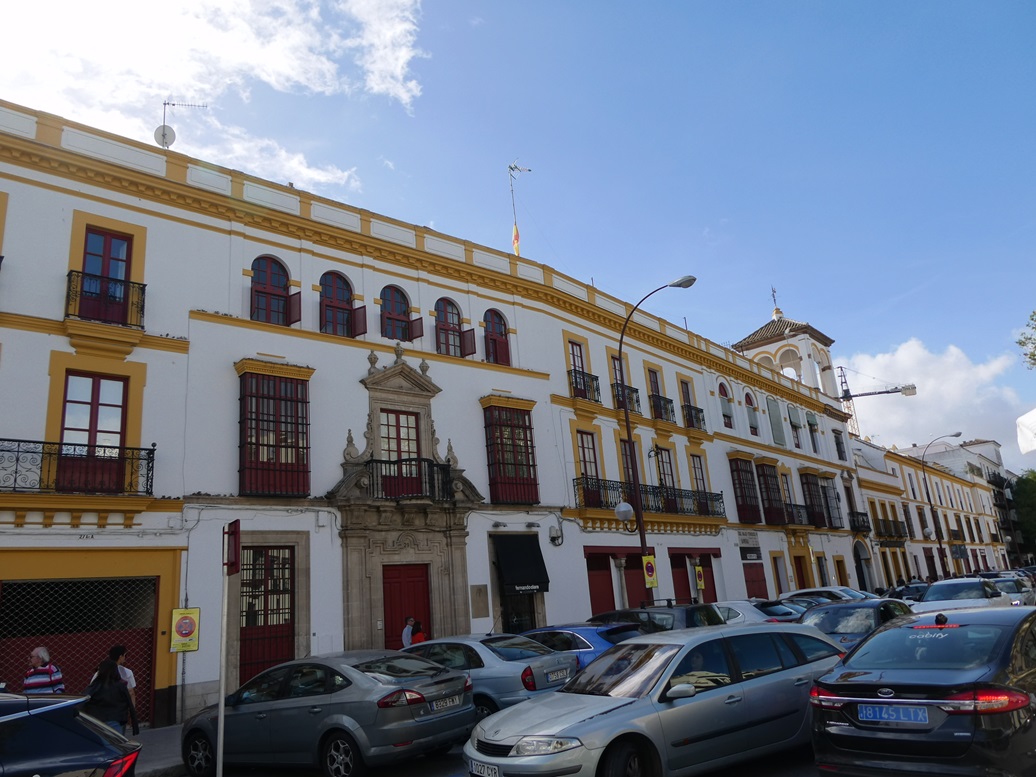
Spoiler Alert: To finish off Carmen, so to speak, we went to the Plaza de Toros de la Real Maestranza, the 18th century bullring where, during the final act, Don José confronts Carmen and stabs her to death in a fit of jealousy. We learned that originally bullfighting was used to train noblemen in horsemanship and in the use of weapons for combat.

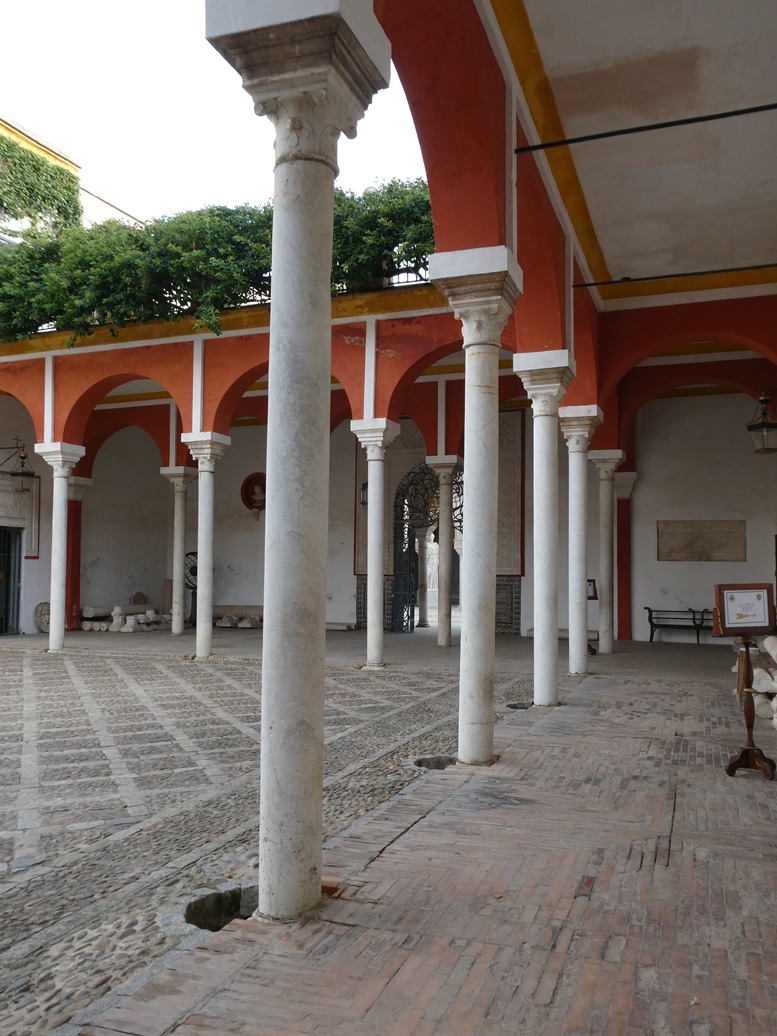
The Casa de Pilatos is so named because the family that had it built in the 16th century claimed to be descendants of Pontius Pilate and had it designed to replicate their ancestor’s house in Jerusalem (interior photo in first paragraph). Although more modest in size, this palace had similarities to the Real Alcázar with its glazed tiles, statues, frescoes, and paintings. Many scenes of the 2009 movie The Barber of Seville were filmed at the Casa including the aria “Largo al Factotum” that we knew simply as “Figaro, Figaro, Figaro….”
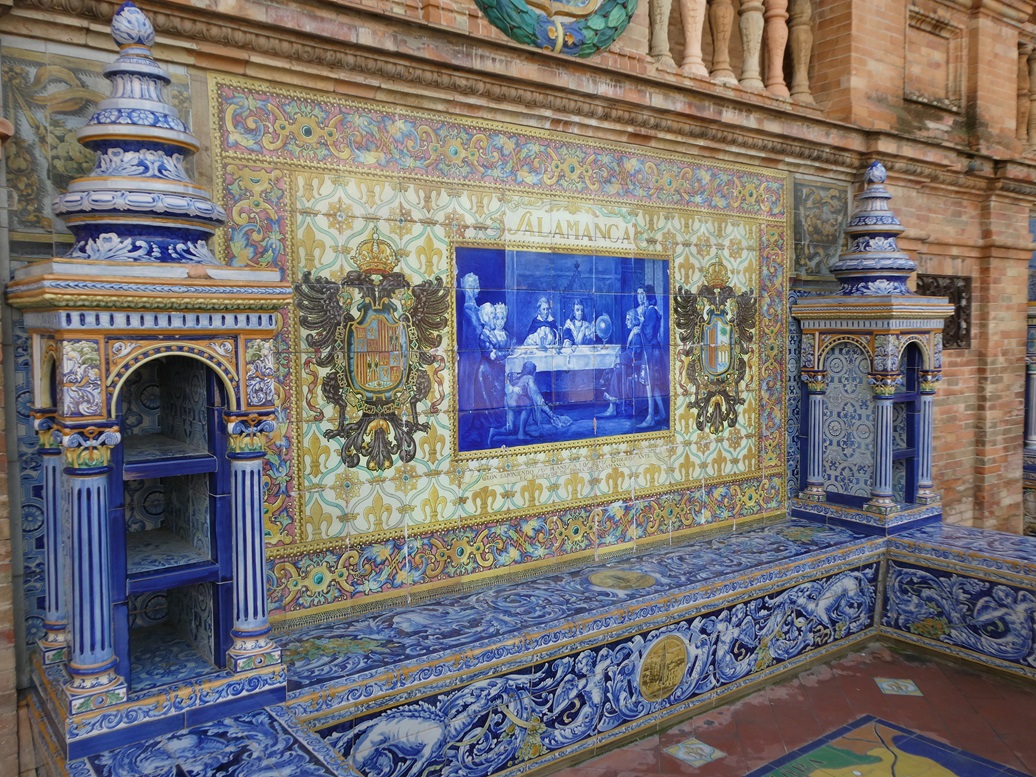
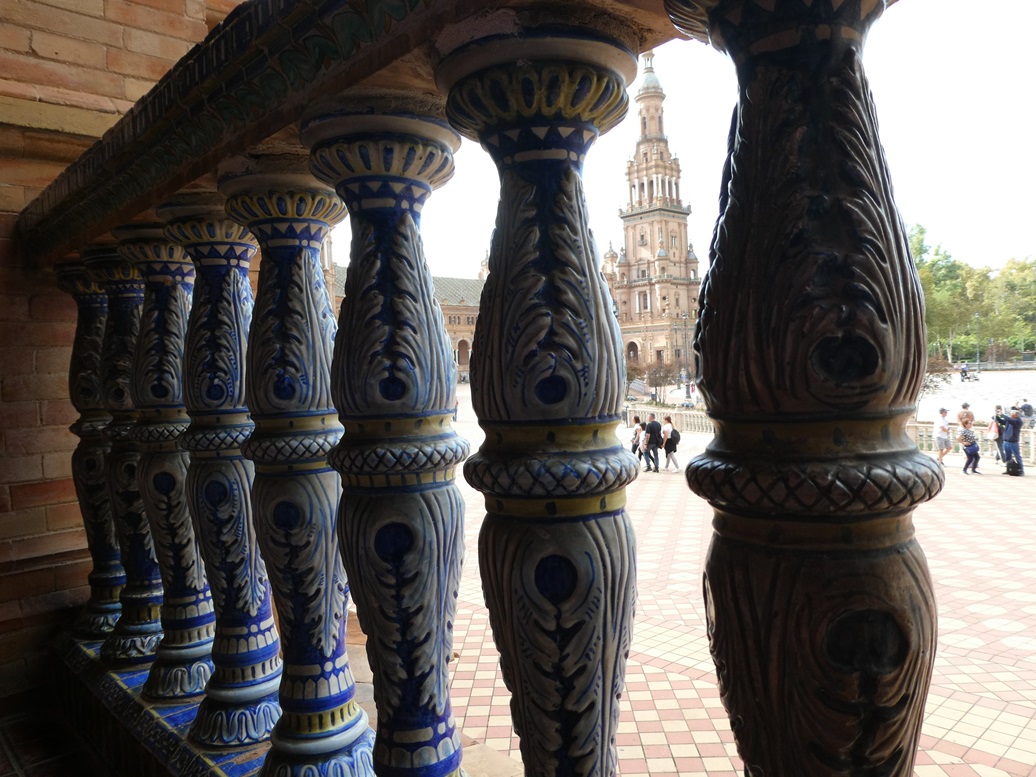
The huge semi-circular Plaza de España (featured photo across the top of today’s post) was built for the 1929 Ibero-American Exposition (a world’s fair) and has a canal and a matching curved palace. In front of the columns and archways are 48 ceramic tiled alcoves that highlight all the provinces of Spain. The final scene of the 1954 version of The Barber of Seville was filmed here.
For a green break from all the paving stones, we walked off the Plaza into the Parque de María Luisa, with its 34 hectares (84 acres) of parklands filled with palm and fruit trees, elms, and pines. Pools, fountains, shady pathways, and benches offered a nice change from the city bustle.

Every guide that we looked at said not to miss “Barrio de Santa Cruz: Seville’s Most Charming Neighborhood” known during the medieval era under Moorish rule as the Judería (Jewish quarter). You do get the old world feeling of narrow lanes, cobblestones, shady courtyards, and whitewashed houses. It’s also the location of the Museo del Baile Flamenco (Flamenco Museum) that features costumes and other displays, is a dance school, and has daily demonstrations of this captivating art form. We didn’t even really need to go inside since we had already enjoyed watching many talented street performers dancing flamenco in various corners of the city.
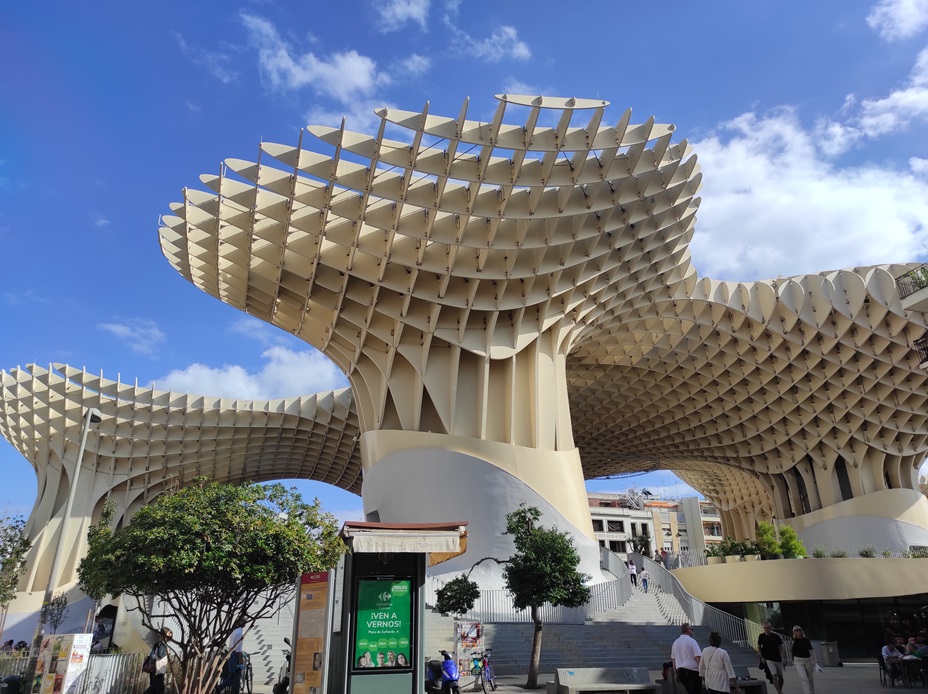
To finish out our time in this ancient city we went on to something much more modern and unique. Officially called Metropol Parasol but locally called Las Setas for their mushroom shape, this walkway and viewpoint was installed in 2011 at 26 meters (85 feet) above the ground to provide a perspective over the rooftops and monuments.




 Let's Live In France
So many stunning things to see in Seville. Thank you for the great tour!
LikeLiked by 2 people
You are living the life! Lucky tourists! Thanks for the write-ups.
LikeLiked by 2 people
You’re right, John and grateful we are, especially since there’s so much more to see!
LikeLike