

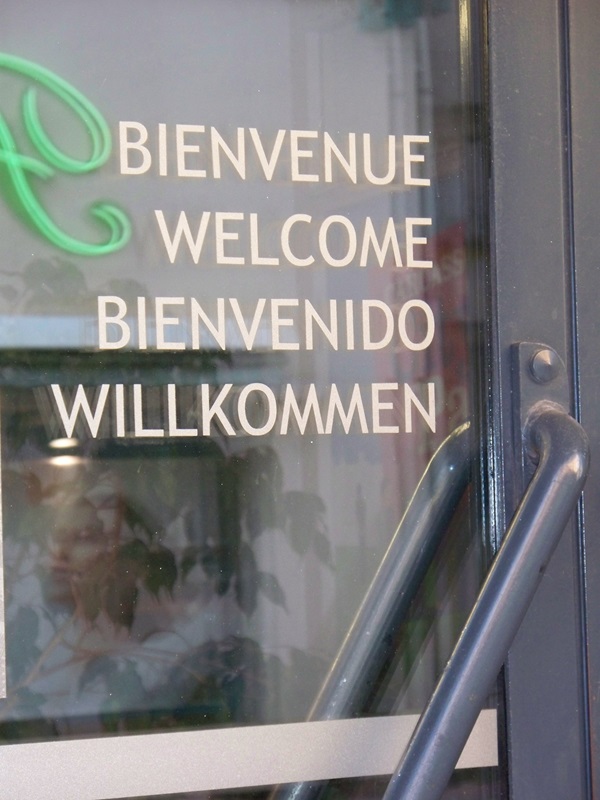
There’s a “Good News” website that daily provides a few stories that emphasize something positive that might have been missed by the mainstream news sources. In the past we’ve referenced a few of their articles here on the blog with discussions about the environment, healthcare, and public transportation. A headline that I saw began with, “America Has a Higher Percentage of Bilingual Citizens Than the French…” so I certainly wanted to find out more about that.
Even before we moved to France, we had been vacationing here and in the surrounding countries for years. You may recall a 1969 movie, “If It’s Tuesday This Must Be Belgium” where a group of Americans is on a 9-country, 18-day trip in Europe that resembled my first transatlantic venture to “5 Capitals in 7 Days” at Christmas. The impression I had, that still seems to be true today in large cities here on the continent, is that in addition to their native language, many also speak English and at least one other language. Of course, when you’re on vacation you generally only encounter people who are used to dealing with tourists—hotel and restaurant employees, shop keepers, bus and train ticket checkers—who get to practice their skills daily. However, outside the main population centers the story can be different.

According to an organization that promotes being bilingual, “America, the Bilingual Project”, the US average for the number of bilingual citizens is 23% or about 76 million Americans. Not surprisingly, 66% of those folks speak English and Spanish while there are sizable numbers that add Tagalog (Filipino), Vietnamese, Chinese, and yes even French into the mix. Since the United States has historically welcomed immigrants—”Give me your tired, your poor, your huddled masses yearning to breathe free”—speaking two languages at home seemed a natural development to me. Interestingly though, it appears that up until 1960 the trend was to totally abandon your native language in favor of speaking only English.
In France, King François I declared in 1539 that all legal documents had to be written in French and in 1992 it was enshrined in the constitution as the “language of the Republic”. During the intervening 450 years, local dialects diminished, sometimes being prohibited from being taught or spoken although that trend has now reversed. In Carcassonne there is a school to learn Occitan, this area’s native language and there are even a few government signs, including the one at the train station (today’s featured photo at the top), written in both French and Occitan. And that “Welcome” sign in the first paragraph; it’s on the door of our city’s Office of Tourism.

By the way, for new immigrants to France, the rules have recently been tightened regarding language requirements. You can still get a one-year renewable visa to live here with just some knowledge of basic French. However, when you are ready to trade that in for a 10-year resident card you’ll need to show that you have at least a language level of B1, meaning that you can function effectively in most everyday situations. To apply for citizenship you now need a level of B2 that makes you a confident user in most social, academic, and professional contexts.
Back to that headline in the first paragraph about the rate of bilingualism in the US, France, and elsewhere. The average in Europe is 25%, the US 23%, and in France 20%. Our experience, when we at least make an effort to communicate in another language, turns those numbers into 100% as the other person seems just as eager to talk to us as we are with them.
America the Bilingual website
 Let's Live In France
Hi both – thanks for all the many thoughtful and thought provoking posts across the year. Christmas greetings to you both and happy holidays. Joyeux Noël 🎄
LikeLiked by 3 people
Thanks, Gary! It’s fun for us to put the blog together and it’s a pleasure to know that you enjoy reading it. We too wish you a Joyeux Noël 🧑🎄
LikeLiked by 1 person
bonnes fêtes to both of you from Paris. Thanks for continuing to write this blog. I look forward to it.
LikeLiked by 2 people
How nice of you to say that, Stephanie, thank you. Bonnes fêtes !
LikeLike
Interesting stats
LikeLiked by 2 people
As ever, an enlightening and interesting post, and with snow! Being bilingual is a gift for mind and spirit – schools everywhere should be aiming for a much larger percentage of students in language studies. In the meantime, I’m still working toward B2 !
LikeLiked by 2 people
Ah yes, the snow. It’s just for the holidays ⛄ And you’re working toward a B2? Bon courage!
LikeLike
Thanks Bob, interesting article. Bonnes fetes to you and Bill.
LikeLiked by 2 people
Bonnes fêtes ! 🎊🎄
LikeLike
Thanks Bob. Bonnes fetes to you and Bill. Safe travels in 2025.
LikeLike
Your post arrived on the same morning I was awakened by a sequence of WhatsApp messages from my future landlord in France. Although I’ve read in “The Connexion” that English is becoming more popular in France especially among the young, my 30-something landlord knows only a tiny bit of English. While I was in France for the first time recently, my limited spoken French was understood well enough (pronunciation is not bad) but I had to ask people to speak slower than they normally would. I’m sure they simplified their speech for my sake by avoiding slang and contractions, and those who knew enough English switched over. As many others have pointed out, I did not encounter one instance of rudeness or distaste at my limited French – quite the contrary! Still, I’m hoping that by June I’ll have done plenty of online study and watched a lot of French TV and movies using an app that provides subtitles in both languages and enables me to create flash cards for reinforcement. When I arrive, I’ll be looking for those French classes you’ve mentioned in Carcassonne to expand my French and to integrate locally. In the meantime, I’ve used some excellent translators on the computer and phone, which is how I’ve been verifying what I think is being said in French as well as how to express myself in French. My landlord insists on my using English in WhatsApp, but based on our initial text and voice communications, I’m sure he must be using a translation app to understand my texts, especially those concerning the rental agreement due to the terminology used.
Re: the distribution of multilinguals in the U.S. – apart from the proliferation of Spanish-speakers across the country, there are of course pockets of multilinguals wherever there are immigrants. In my public high school 50 years ago there were ESL classes for kids from Puerto Rico and Central America (Spanish), the Azores, Brazil, Cape Verde, (all Portugese), Haiti (French) Greece, and a few African countries (mostly French). I visited the high school 20 years later, and there at least a hundred different flags hung from the ceiling in the cafeteria, each representing the native country of current and former students. I’m sure it’s kids like these who comprise the bulk of multilinguals in the U.S. There are also some like me who studied a foreign language but most of us probably wouldn’t be considered multilingual. But here I am 50 years later, attempting to complete the language – and cultural – education I started 50 years ago in high school. I needed a challenge – I think I’ve found one! Concerning my own family, my great-grandparents were all immigrants, from Canada and Scotland, yet I feel as American as anyone I know. I’m sure it’s the same feeling for those “foreigners” who attended public high school with me and those who have attended ever since. Joyeuses fêtes !
LikeLiked by 2 people
Thanks, Rich. Good idea about the flashcards. When studying for the French citizenship exam I found the free ones available on Quizlet very helpful and you can create your own set as well. Joyeuses fêtes !
LikeLiked by 1 person
When I check your blog on Sunday morning I never know what the topic might be, but it’s always interesting and thought provoking. Thanks for keeping us in touch with France week after week. Happy Holidays to you two.
LikeLiked by 3 people
Thank you, Carolyn. That’s really nice to hear. Happy Holidays to you as well!
LikeLike
You’ll get there, Katherine. Je te fais confiance !👍
LikeLike