


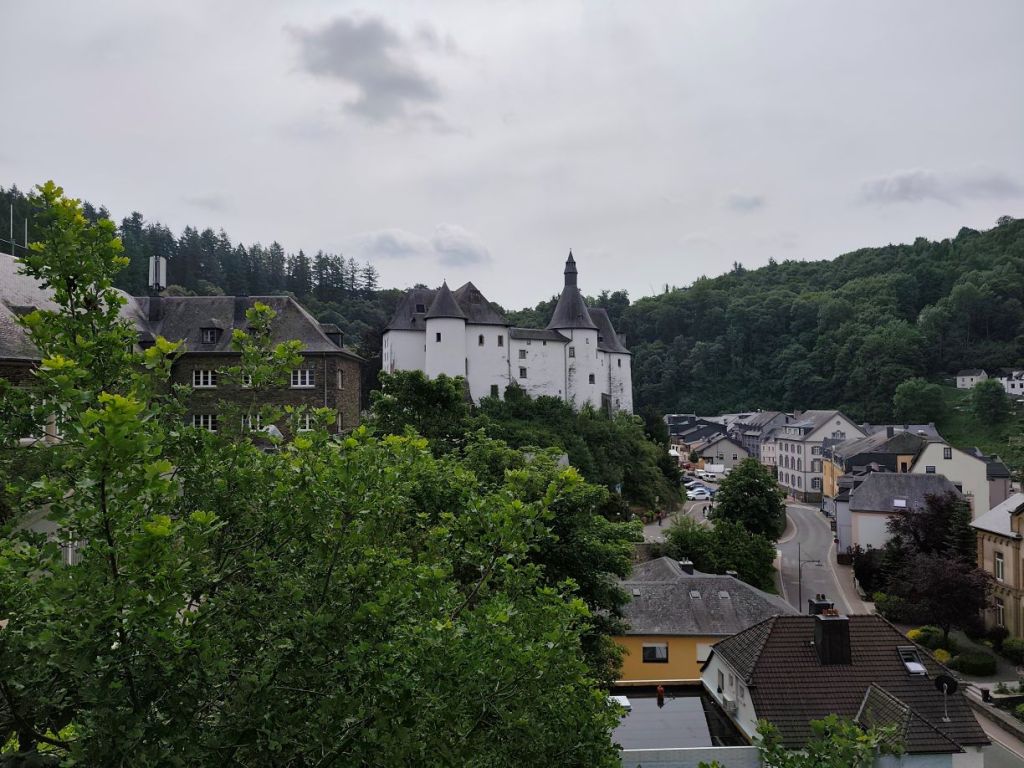
Within the city of Luxembourg we’d had access to all three forms of its free public transit system: bus, tram, and funicular. Now we were going to move out into the country of Luxembourg to visit two historic locations, but like in the previous few days this wasn’t going to cost a centime to get there. The first day would require a train and then a connecting bus to Vianden, that one guide book described as, “…quite simply, the most picturesque little town in the Grand Duchy….” The next day we were on a train for about an hour to medieval Clervaux to see its 12-century castle (its garden view is in this paragraph) and the Benedictine Abbey.

We knew the famous French author, Victor Hugo, for his works including Les Misérables, so we were surprised to be walking by a home with his name attached not far from the main bus station there in Vianden. Because of Hugo’s opposition to the authoritarian ways of Napoleon III, he spent almost 19 years in exile elsewhere in Europe, including several stays in this house that has now become a museum of his life.

From there it’s all uphill to a plateau where some form of fortification has existed since Roman times. In the 9th century the castle that stands today got its real start although it was greatly altered over the centuries since, eventually falling into ruin before restoration started in 1966. Efforts were made to furnish the interior authentically to honor the former inhabitants, particularly those from the House of Orange-Nassau who went on to become royalty of the Netherlands and grand dukes of Luxembourg. Hint: You can take bus #180 (it’s free!) to the Place Engellman stop near the castle to save some uphill climbing.

Headed back downhill towards the river to find lunch beside the water, we paid special attention to the way that “picturesque little town” unfolded before us: charming lanes and narrow streets, quaint buildings clinging to the hillside, a medieval bridge below and the stunning castle behind. Today’s featured photo above shows you that view.
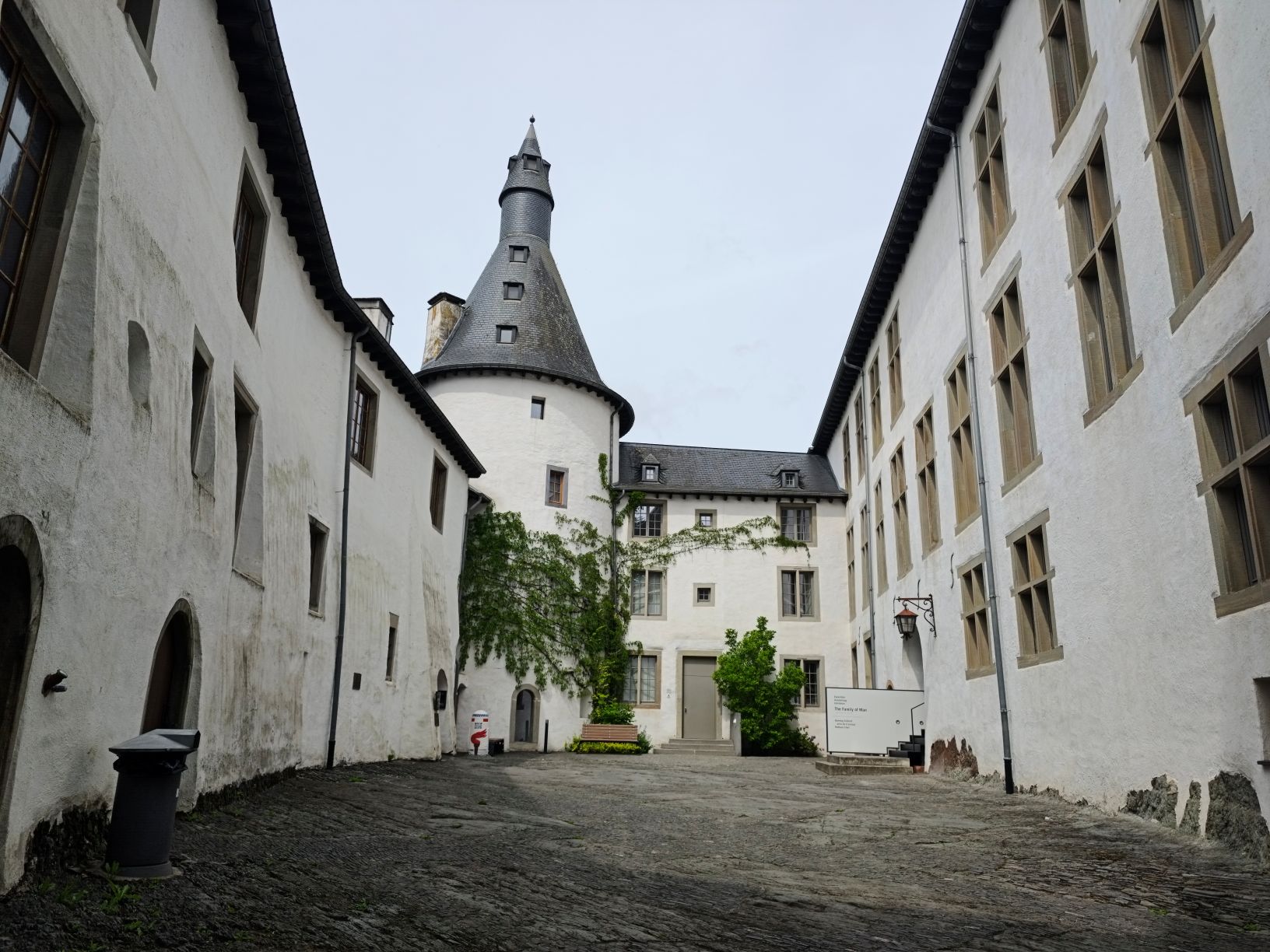
Just as we were surprised to learn of the connection between Victor Hugo and Vianden, we knew of the Battle of the Bulge from WWII but hadn’t realized the significant role that the next town on our itinerary had played in that event. In fact, our first stop for the day was at Clervaux’s 12th century castle that was badly damaged in December 1944 during Germany’s last major offensive of the war. Fortunately for us, it’s been restored to reflect its origins plus the changes made during the 15th and 17th centuries and now houses a museum dedicated to that pivotal battle.
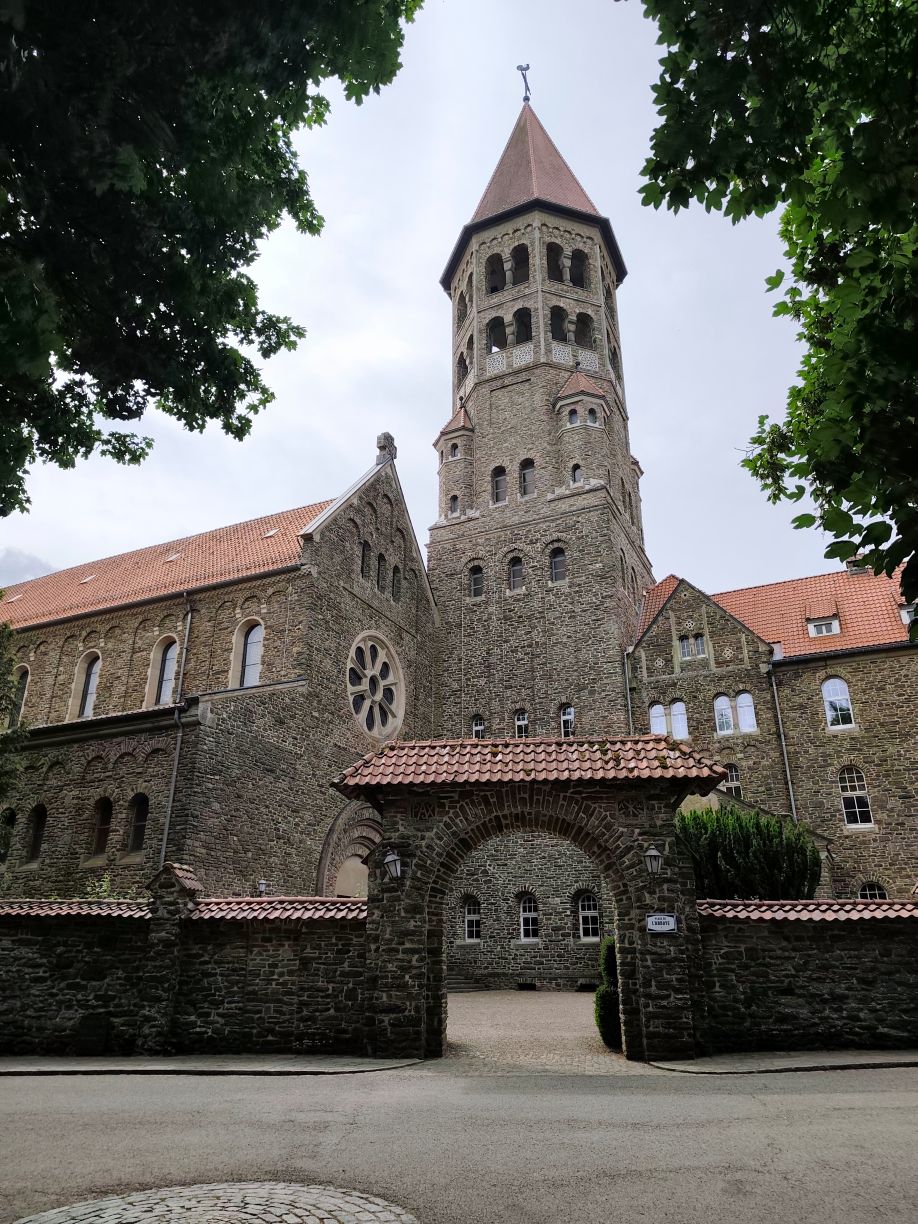
The other literally “big” monument in town is the Benedictine Abbey that was founded in 1909 by French monks who were not content with the 1905 separation of church and state in France. While there is an active monastic life even today, it has not been uninterrupted since its founding. In 1941, the building became a Hitler Youth training center that was not abandoned until the end of the war in 1945. We understood that the daily 10 AM mass would be especially interesting to visitors who can listen to Gregorian chants within the abbey church’s resonant acoustics.
Our walk back to the station was easy enough, especially since it was all downhill until we reached the main town with restaurant and café choices for lunch. From there we followed the river route to our waiting train and on to another country the next day. Details in Belgium next time!





I love how you two let the train take the strain
LikeLiked by 2 people
And a bit easier than on a bicycle 🚴♀️😁
LikeLiked by 1 person
I wouldn’t attempt it on a bike, not unless I had following support vehicle.
LikeLiked by 1 person