The tablecloths of Provence

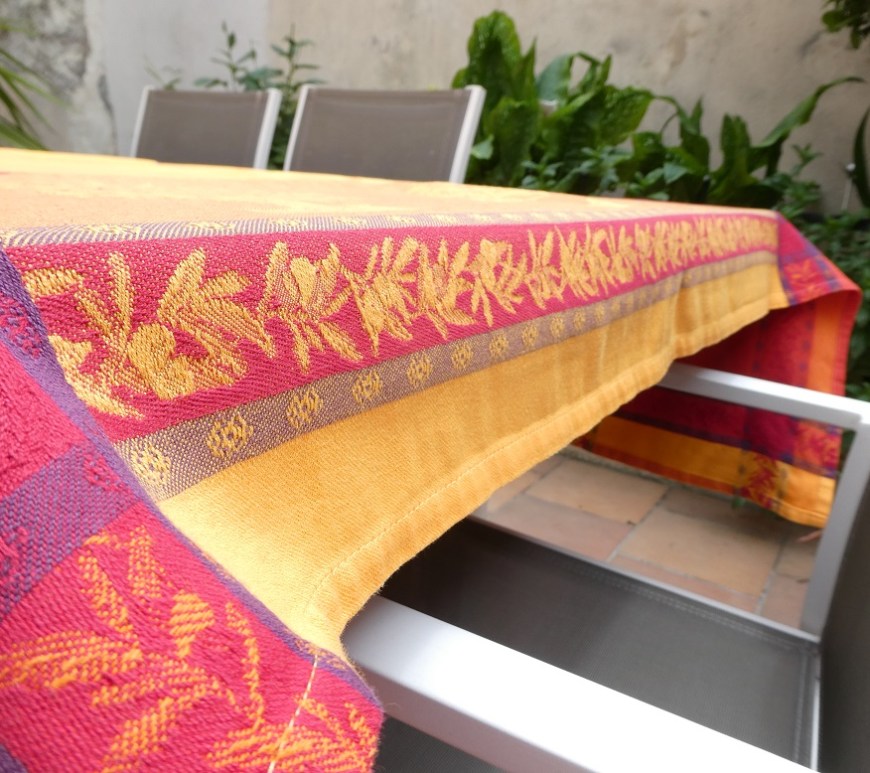
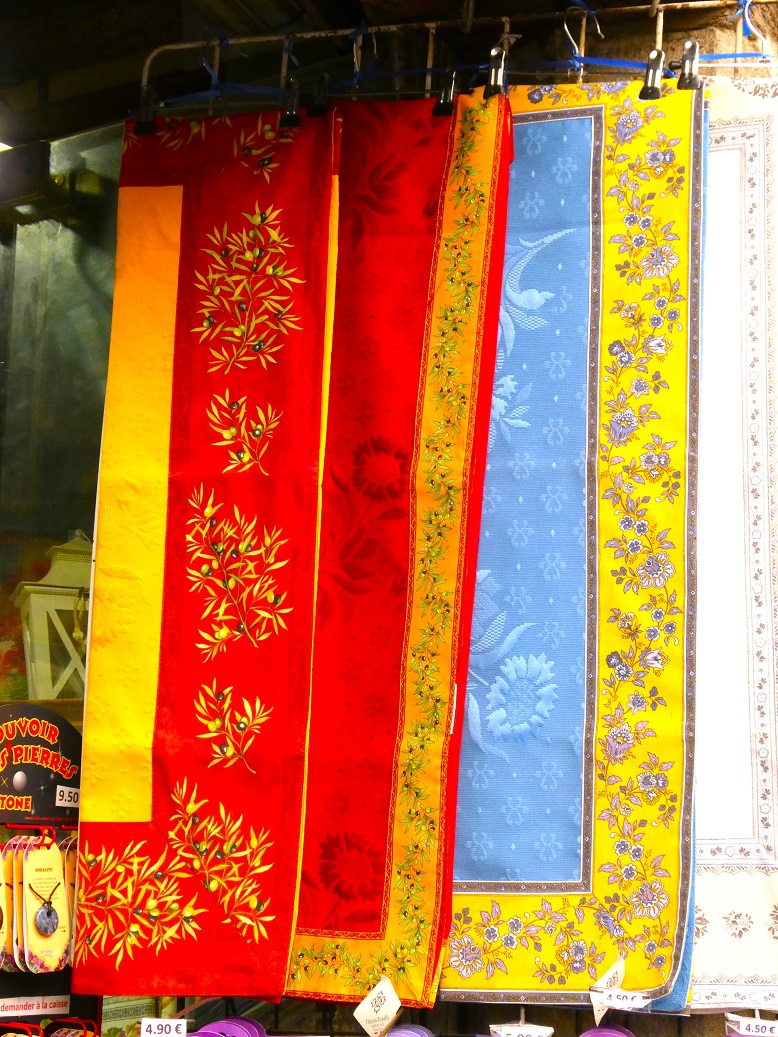
If you want to become a French citizen, one of the requirements is to successfully complete an interview with an immigration officer who will ensure that you are fully integrated into the society here. You can be asked questions about history, geography, culture, values, government, current news and politics, and your daily life. A task that I see often mentioned is to name the symbols of France. According to the Livret du Citoyen (Citizen’s Booklet) that we are given to study, those should include the national anthem, the flag, and Marianne the statue of whom appears in every town hall. Additional responses could be the 14th of July, the official seal, the faisceau de licteur design that appears on the cover of passports, and even the rooster. While those seem to be official and easily recognized by anyone living here, you might get a different response if you asked a visitor to this country. Based on movies and personal experiences I bet that you would hear, “the Eiffel Tower, baguettes and croissants, wine and cheese, blue-and-white striped shirts and berets.” Let’s add one more to the list: the tablecloths of Provence.

Continue reading “The tablecloths of Provence”

An Afterwork at the winery

During the Covid lockdowns when one of the few reasons we could leave the house was to make essential purchases, Bill discovered a way to easily take care of one of those required items. A wine store was offering free delivery. We prefer to try new wines before we buy them but that wasn’t an option in those restricted times so we had to create our own tasting events at home for just the two of us. While getting the bottles to our front door was simple enough, deciding which ones to choose was more of a challenge since the store stocks wines from 1250 vintners who cultivate 49 different grape varieties. France lifted its state of emergency surrounding Covid on August 1 so now with all events in full operation it was time to visit this Cave à Vin in person during an evening they called an “Afterwork”. 

Continue reading “An Afterwork at the winery”

Geneva in 4 days ꟷ part 2

During the first part of our visit to Geneva, we had spent most of our time on the eastern and southern shores of the lake, so we crossed the bridge for the day. We’d been to the United Nations in New York and now we wanted to see its equivalent at the Palais des Nations (photo on the left) where 25,000 delegates meet each year. We didn’t have time for a guided tour indoors because within the Palais park grounds we wanted to see the Ariana Museum that houses thousands of examples of glassware and ceramics from the Middle Ages through the 20th century and to have a school lunch.

Continue reading “Geneva in 4 days ꟷ part 2”

Geneva in 4 days ꟷ part 1

We’ve now lived in Carcassonne for over 6 years and during that time we’ve had lots of family and friends from outside of France visit us here. When we have the opportunity to see some of those same folks again, we like meeting up with them elsewhere in Europe that gives all of us the chance to see something new. That was the case with our English friends, Gaynor and Pete, who were attending a reunion in France near the border with Switzerland. Since they had to fly into Geneva and we could easily get there by train, that made a logical meeting point for the four of us. 

Continue reading “Geneva in 4 days ꟷ part 1”

Tour de France: City by Bike

In the UK we have seen highway signs proclaiming “Britain’s Tidiest Town”, “Tastiest Cuppa” for tea lovers, and even “Cleanest Loo”, all to indicate that a community had been awarded the nation’s top honor in a certain category. France has similar declarations that are proudly posted at the roadway entrance including “Most Beautiful in France”, “Village in Bloom”, “City of Art and History”, and “Active and Sportive”. The level of achievement, typically from 1 to 4, is indicated by the number of stars, flowers, Olympic laurels, or other appropriate symbols based on the theme of the award. Carcassonne has won many of these and thanks to the Tour de France that whizzed through town last weekend, we also have a bicycle emblem as a Ville à Vélo otherwise known as a City by Bike.

Continue reading “Tour de France: City by Bike”

La Fête Nationale aka Bastille Day

There’s a link in the right hand column on this page to a 5-minute video that condenses the half-hour fireworks display over the medieval walled Cité of Carcassonne on July 14, 2016. That was just a few months after we had moved here and it was quite the introduction to our first Bastille Day in France, except no one here calls it that. Officially it’s “‘la Fête Nationale Française” although we typically hear simply “la Fête Nationale” or even “le quatorze juillet” just as in America we might say “the fourth of July” instead of the more formal “Independence Day”. In researching the history behind this holiday I discovered some fascinating connections between George Washington, Thomas Jefferson, and Bastille Day.

Continue reading “La Fête Nationale aka Bastille Day”

You live where?

When we’re on vacation we encounter a lot of people and inevitably in conversations the question of where everyone is from comes up. If we’re talking to French people there is instant recognition when we say, “Carcassonne”, and with other Europeans once we initially say “France” and then add our city, they too seem to know the place. After all, it is Europe’s largest fortified medieval city that is surrounded by 3 kilometers (1.9 miles) of double walls enhanced by 52 towers for surveillance and defense (photos above). In a busy year there can be 3 million visitors, half of whom are Spanish, one quarter French, with the remaining quarter coming mostly from the surrounding countries. That, plus the article highlighted below might explain why, if we meet an American on our travels, we almost always hear, “You live where?”

Continue reading “You live where?”